Showing posts with label nature. Show all posts

Tuesday, November 20, 2018

"IF YOU ARE NOT CONNECTED WITH NATURE, YOU PRODUCE POLLUTION"


INTERVIEW WITH MARCO CASAGRANDE OF CASAGRANDE LABORATORY
Edzard Mik, ARCHIDEA #57 / 2018


Marco Casagrande considers himself an animist architect. Architecture shouldn’t impose itself on nature. Physical presence is the key. “I like to build a fire before I start constructing. Sleeping at the site also helps me to get connected with it.”

Photo: Ville Malja

The sensual entanglement of ruins and wooden structures, refurbishing an abandoned building with provisions for trees and plants, an organic structure of willow branches in between depressing residential towers: what stands out in the provocative architecture of the Finish architect Marco Casagrande is an ambivalent attitude towards design. His designs have a sophisticated quality, yet he also seems to criticize design in his work.
“I am not comfortable with architecture that has become design,” he explained. “To me that kind of architecture feels like pollution. Architecture should be connected with reality. Design stands on its own. It tries to replace reality and to be independent of it, solely expressing the designer’s point of view. I cannot put my thumb on the precise reason, but I feel that design is my enemy.”


How can you possibly escape “design” while making architecture?

“I always try to ruin my own design. Architecture, real architecture, is not about imposing an artificial order on reality. It is about digging it out like an archaeologist. Therefore I work on a project until it starts to become itself. Sometimes, while designing, a moment comes when I feel that it is 'there'. Often it has to do with the site. I work at different places. I am like a parachutist, I am dropped in somewhere and then I have to open myself up to the place, to break myself open, to exhaust myself, until I reach a state of feeling the site. It's essential to get that feeling and to keep it. What I should do or shouldn’t do then starts to reveal itself. This process is not at all easy. And it isn’t necessarily pleasant. It can even be painful, especially if I try to rush at it. But I know that my own project first has to die. Every good project has to die at least once, and then it gets the chance to become more than you ever could think of beforehand. Of course, it mustn't die completely. But it has to die in such a way that you lose control over it. Control is another enemy, besides design.”


Drawing: Marco Casagrande
Photo: Jussi Tiainen
Photo: Sami Rintala

Do you have particular strategies for giving up control?
“I like to build a fire before I start constructing anything. Besides, I need a fire because I have to eat, dry my clothes and repel mosquitoes. Building a fire is a powerful method for connecting with the site. It means that I have to find out where to gather wood and I have to check the direction of the wind, before I can decide on the right place to build a fire. It often turns out in a later phase of the project that this place is  a meaningful place in the building. Sleeping at the site also helps me to feel the connection. It teaches me where insects are coming from and how the wind changes during the night. It generates encounters, for instance with local people who sneak through the site, a grandmother who takes one brick because she needs it for something.”

                Can you apply that strategy equally well in the city?
“It definitely works in the city too. In the Ruin Academy in Taipei, in an abandoned building, I took away all the windows. But while sleeping there I found out that I had created an unpleasant acoustic situation. The rooms echoed with noise from the traffic. So I had to grow bamboo in the windows and make wooden structures to damp out the echoes. Physical presence is the key. You can be present mentally, but you have to be present physically as well. Site specific conditions materialize in your body; you can only understand them through your body. Being together with others physically, working and sweating together, is a significant tool for communication because we all share a similar body. We share the same physical sensations, independently of our culture.”

Treasure Hill, Taipei, Taiwan (2003). Photo: Stephen Wilde
Photo: Marco Casagrande

But in the end you are constructing something, which means that you create a projection for the future, beyond your presence in the here and now.
“I am not so sure any more what time means. I used to think of time as being born, growing up and dying. But now I am growing more aware of different time scales, unconnected to my own lifespan. The times of other people, of volcanic rocks and granite, of the ants that crawl through the site and the plants and trees that grow there, of the wind and the typhoons, the time of the Earth and the Moon. Each phenomenon has its own time, and I want to understand them all and let them meet for instance, to direct the wind so you are touched by it while sleeping. Or to raise the floor so snakes can crawl under it."
Chen House, Sanjhih, Taipei County, Taiwan (2008). Photos: AdDa Zei


Do you mean that you try to orchestrate different times?
“I know something about atmospheric circulation and the course of the sun. But essentially, I don’t know what I am going to do in advance. I trust in accidents. I try to make a platform for accidents. I dig myself in and something gets constructed out of the mess. Treasure Hill in Taipei was an illegal settlement in a complex of abandoned bunkers. The local government commissioned me to develop an ecological master plan for Taipei Basin, while the same government was destroying Treasure Hill. I found Treasure Hill more interesting. I started a farm where a previous farm was destroyed by government officials. But I did it in the wrong way because my model of farming was Finnish, which means you put seeds in the ground and plants will grow. An old lady who used to own the farm passed by and criticized my work. She told me that a typhoon would wipe away everything I had done. She instructed me on the right way to do it. I had to dig ditches and plant the seeds in specific places. Finally the farm began to look like a farm. At the same time the whole settlement was watching me. Together with the grandma instructing me, it became a piece of theatre for them. They realized that she had accepted what I was doing, rebuilding her farm. They lost their fear of the government, showed up with tools and began replanting their own farms. An accidental encounter set off the whole process of rebuilding farms and eventually Treasure Hill.”

Architecture is usually concerned with solving problems. Modernity can be seen in this light too. Do you consider your work as a criticism of modernity?
“Modernity is the aesthetic representation of industrialism. But I try to think positively about industrialism, which is of very recent origin. Maybe it will learn to become part of nature some day. Maybe it will become an organic machine. To achieve that we must open ourselves up to site specific knowledge. I would not call it old knowledge, because knowledge is changing all the time. However, industrialism still assumes that it is independent of nature. Nature is often seen as something hostile, with its floods and typhoons. Through industrialism we create a machine that is completely functional and not related to nature, although it uses its resources. To me, nature is a specific mentality, a mind that thinks of just one thing: to maximize life in the given conditions. If you are not connected to nature, you produce pollution.”
 
Bug Dome, Shenzhen, China (2009). Photos: Nikita Wu

How do you see your work in relation to modernity? Is it a proposal to build differently, or is it a kind of meditation on our attitude towards nature? In other words, is it more like a work of art?
“I consider myself an animist architect. First of all I attempt to connect myself to the mind of a city. Because I can usually communicate only with a limited number of people, I spread rumours through the city. You cannot control rumours. They change all the time. They are like creatures. You can only send them but not control them. Rumours are powerful. I think you could design cities just by rumours. Often my work functions as the source of rumours. People react to them easily. Sometimes I talk about urban acupuncture. That is basically the same. I asked students of the Tamkang University in Taipei to build Trojan horses in order to 'attack' the city. The hidden content was of course not soldiers, but letters from citizens to the mayor expressing their wishes, thoughts and complaints about the city. The rumours spread and we collected thousands of letters. The media became interested. Finally the mayor had no choice but to receive us and to read some of the letters aloud.”

You did some projects with ruins. What do you find attractive about ruins?
“I find them hope-inspiring. There is a lot of hope in ruins. A ruin is architecture that has become part of nature again. Nature reads architecture easily. Mosses start to grow, then plants and trees. To me that that is very beautiful. People usually try to seal their home against the intrusion of nature. To keep nature out of the house, you have to clean it and maintain it all the time. It's a form of control. But if you abandon the house, nature will break in and the house will become part of a life-providing system. I call this second generation architecture. What I am interested in is third generation architecture, when you return and find that the house has become part of nature. How can you live there?  There is plenty of space left over, but perhaps you have to accept that the interior has been penetrated by a tree and plants are creeping out of the cracks. The house is no longer shielding you from nature. It has become an intermediary between you and nature.”

You went to live in a ruin. Can you explain how that worked out practically?
“When I was working at Tamkang University, I told the Dean of the architectural department, professor Chen, that I didn’t want to live in a house any more. I asked for a ruin instead. He found a derelict rice packing factory for me next to a rice paddy. My wife Nikita protested that we could not live there because rain came in through the roof. So my first step was to build a roof above the bed, and the next was to provide facilities for keeping ourselves clean. We could get water in buckets from the nearby river. I fixed up a heater with a gas tank for hot water and cooking. We went from one step to the next until finally we could move in.”

You didn’t design anything?
“I don’t think you can really design architecture. Of course, you can reach a certain level by drawing and making models. But that does not get to the essence of architecture. I only understand what needs to be done once I am occupied with building on the site and experiencing the space growing around me. This teaches me, for example, to make a small adjustment so that I can see the moon at night. If you base the construction of a building only on drawings, you force it to comply with preconceptions. Then the architecture becomes strangely crippled, growing out of nothing. Architecture shouldn’t impose itself on nature. Architecture should be pliant, an undecided form.”


Thursday, January 7, 2016

ULTRA-RUIN

ARKKITEHTI 6/2015 Finnish Architectural Review
valokuvat | photos AdDa Zei

teksti | text Marco Casagrande


Architecture gives the commands and architects listen. Actually, nature gives the commands and architecture takes form. An architect is a design shaman who communicates with this reality. Design cannot replace reality or nature. Human control must be opened up in order to let nature step in. Architecture must be ruined. Ruin is when man-made has become part of nature.


Architecture is a site-specific instrument through which the great voice of nature starts to resonate and find form. This great voice is weak and needs great presence, sacrifice and sensitivity to be heard. An architect is one of the sensitive beings to hear this voice and protect the sound. Architecture either is or it isn’t. It cannot be speculated. Architecture is a real reality.

“What really happened to Porcupine?”

“One day he came back from the Zone and became amazingly rich, amazingly rich. The next week he hanged himself.”

– Stalker, Andrei Tarkovsky


People live in space and this connection can be art, a higher thing than what could be designed. Architecture is an accident, which is a higher thing than human control. In order to understand the accident and to let life run through it, one must be present. To be present is the key of all art. This crack in human control is the acupuncture point through which the organism of architecture can grow. Biourbanism is a city of cracks. Architecture is a mediator between man and nature, connecting human nature with the rest of nature, reality. Architecture is the art of reality.

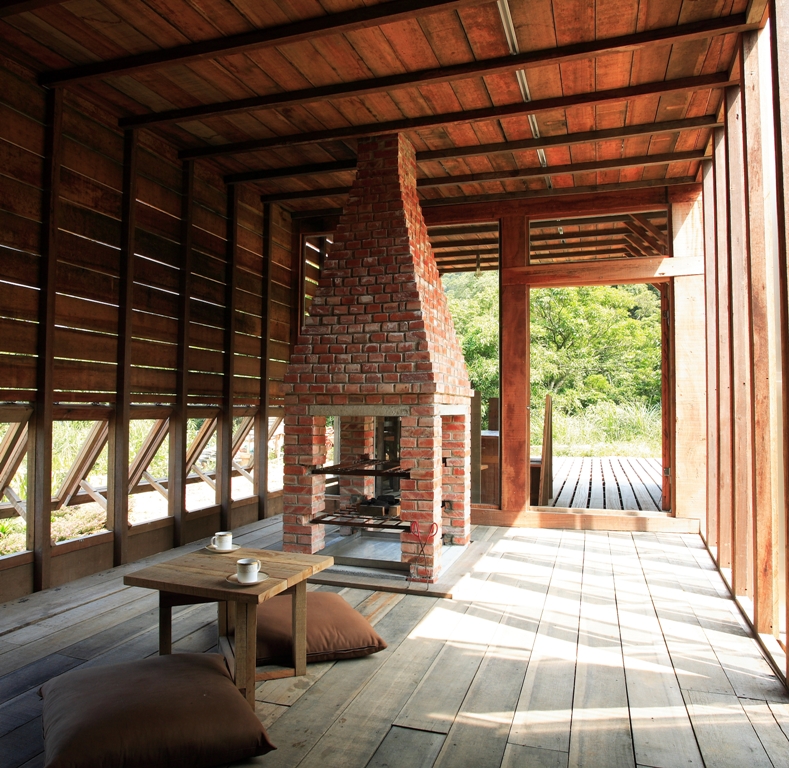
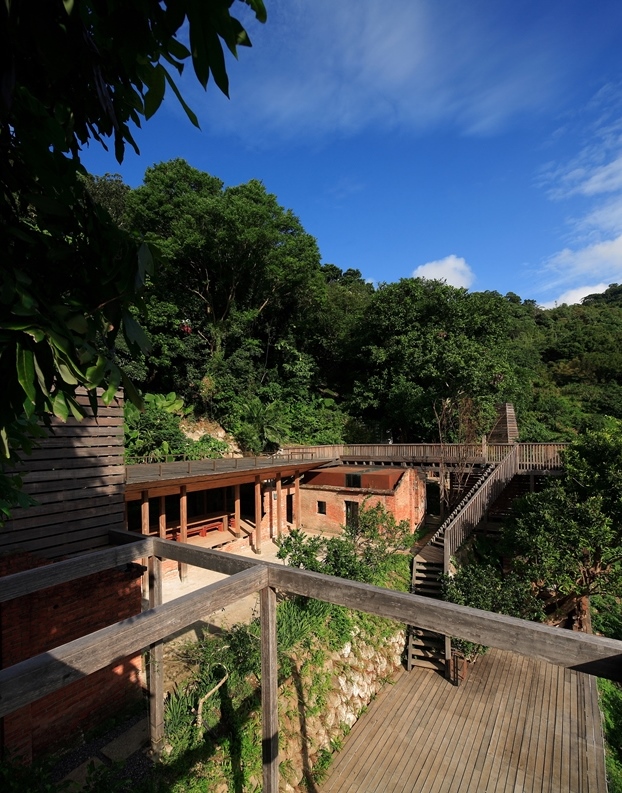
Ultra-Ruin is a wooden architectural organism growing from the ruins of an abandoned red brick farmhouse in the meeting place of terraced farmlands and the jungle. The weak architecture follows the principles of Open Form and is improvised on the site based on instincts reacting to the presence of jungle, ruin and local knowledge.


The complex has a variety of multi-functional spaces and platforms that can be activated for different living functions as well as meditation. The spatial continuity between interior and exterior spaces is flexible – the inside is also outside and the jungle is in the house. Ultra-Ruin is an architectural instrument played by nature including human nature. The main user is a private family, but occasionally the space is opened up for larger meetings.
a - lower deck, b - courtyard, c - loft, d - hall, e - kitchen, f - sauna, g - pool, h - tower

Ultra-Ruin is more of an organic accident than based on industrial control. Architectural control has been opened up in order to let nature step in and human error take place. Architecture is not an independent language and architecture is not talking alone. Architecture needs nature to become part of nature. Ultra-Ruin is a post-ruin condition, where the human has come back to the ruin-house and shares the same space with the jungle.


Ultra-Ruin has been developed since 2009 in close and still ongoing dialog with the client. The first architectural reaction was to build a table around which we could talk, then to build a shelter for this table. The rest of Ultra-Ruin has grown up around this initial impact. We still keep talking and Ultra-Ruin keeps growing as an open form. ark

asuintalo | private house
arkkitehdit | architects Marco Casagrande
osoite | address Yangming Mountain, Taipei, Taiwan
laajuus | gross area 210 m2 + 520 m2 (terassit | terraces)

valmistuminen | completion 2013


Monday, June 22, 2015

Marco Casagrande - concepteur par accidents

EK / Charlotte Fauve:

Vitrine de la recherche sur les milieux habités, le Global Award for Sustainable Architecture distingue chaque printemps cinq personnalités à l’avantgarde de l’architecture. En 2015, le jury présidé par Jana Revedin s’est donné pour la première fois une thématique comme guide : la liberté de pensée. Ce choix marque la mutation d’un prix qui, depuis sa création en 2006 pour promouvoir la construction écologique, suit l’évolution des préoccupations environnementales. Si le développement durable était hier méconnu, il est aujourd’hui consensuel. Au manque de visibilité s’ensuit donc la nécessité d’un approfondissement, comme l’explique Marie-Hélène Contal, directrice du développement culturel de la Cité de l'architecture et du patrimoine, partenaire de la récompense : «Observatoire, le Global Award va désormais explorer chaque année un champ particulier dans la chaîne de complexités. Le débat doit progresser et il faut repérer et soutenir ceux qui s’engagent. » Le palmarès 2015 fait donc la part belle aux esprits hardis, qu’ils soient jeunes rebelles, comme l’Espagnol Santiago Cirugeda, guérillero urbain moqueur, ou grands précurseurs, tel le Danois Jan Gehl, critique engagé de la vie urbaine. Car la liberté de pensée est plurielle, et chacun l’exerce à sa manière, qu’il renonce au territoire vu d’en haut pour celui que dessine le regard des habitants, ou fasse acte de désobéissance pour restaurer l’harmonie du monde. Ces récompenses rendent également tangible le changement des pratiques architecturales. Ainsi, des ateliers de l’école de Talca au Chili aux expérimentations du Finlandais Marco Casagrande à Taiwan, les students workshops qui feurissent sur la planète aident une nouvelle génération de tempéraments affranchis à s’exprimer.


Le Finlandais Marco Casagrande a une collègue architecte : la nature ! «Sa seule loi, explique-t-il, c’est d’exister au maximum. Elle arrive même à se nourrir de nos constructions ! » En créant le Casagrande Laboratory, ce maître d’œuvre fasciné par les accidents constructifs tente de prédire le devenir des cités postindustrielles. Ces « villes de la troisième génération», comme il aime les nommer, s’y décomposent sous l’action conjuguée de la nature et des cultures populaires, à l’image de Treasure Hill, quartier précaire mais si parfaitement durable de Taipei, à Taiwan, que Marco Casagrande réactive grâce à une démarche d’acupuncture urbaine. Des recherches qu’il poursuit ensuite, toujours à Taipei, en y transformant un immeuble délaissé en «ultra-ruine ». Murs et fenêtres abattus, parois trouées de toute part, cette «Ruin Academy » devient lieu d’étude en même temps que résidence d’artistes et d’architectes. Idem pour cette ferme abandonnée, jungle urbaine qu’il change en atelier. Un concept qu’il prolonge aujourd’hui à grande échelle avec Paracity, une ossature en lamellé-collé qu’il s’imagine greffer sur les décombres d’une métropole. Le bio-urbanisme est né ! 

LINK


Thursday, May 29, 2014

RUINS OF THE FUTURE

An interview with Marco Casagrande on the significance of ruins by Liva Dudareva / STRELKA Institute


Stalker / Film by A.Tarkovsky

How did you become interested in ruins?
There was a time when I felt kind of sick or kind of disturbed when I was looking at old drawings of ruins, that were displayed most of the time as romantic establishments relating to the period of the Enlightenment. But then I came across the book called “Dialectics of Enlightenment” by Max Horkheimer and Teodor Adorno. They both belonged to the philosophical school called the Frankfurt School. They had to escape Germany during the Second World War, and both went to the US, where they wrote this book. In short, “Dialectics of Enlightenment” is about how industrialism betrayed the Enlightenment. I was reading it, and somehow got interested again in ruins.

What does ruin mean for the city?
IN MY POINT OF VIEW THERE IS ONLY ONE REALITY AND IT IS NATURE. THE OFFICIAL CITY IS GOING TOWARDS FICTION. ITS JUST A SOME KIND OF MAD DREAM OF CENTRAL HIERARCHIES.
I used to live in Taiwan which has lots of ruins. When the Japanese left Taiwan, they left Japanese houses which the Taiwanese didn’t maintain but neither did they destroy them. Taipei has been growing very fast, and so nature had overtaken these Japanese ruins very quickly, turning them into small ecosystems inside the city. When you have a lot of small holes in the city, which nature takes over, they become points of acupuncture. The city is so fat and lazy, and industrial, and these acupuncture points in the form of Japanese ruins are actually doing some sort of good for Taipei in general, and people feel it. People are very interested, and I got interested in the question of how it is possible that there is this official city, which is polluted and basically trying to destroy nature, while inside the city you have people that are very real. They are using the official city in a very organic way and putting some new layers on top of it. I find it very hopeful. Ruins seem to play some sort of part in it. I started to research illegal communities in Taiwan, and in all settlements the jungle was playing part of it, and urban farming was playing part of it, and also the people. I was absolutely fascinated, because in Taiwan these communities could be in very high densities, without design, official systems or central power. They were real. And that is a key word. In my point of view there is only one reality and it is nature. The official city is going towards fiction. It’s just a kind of mad dream of the central hierarchies. Because it is not real, it is against nature and the symptom of that is pollution and so forth.
I got interested in the reality to the point that I asked TamKang University, where I was architecture professor at the time, to find me a ruin, because I could no longer live in a house. I wanted to move into a ruin. My wife would move into the ruin too. I would no longer teach in the institution, and students would also come to the ruin.

Ruin Academy / Nikita Wu
What kind of knowledge from nature did you gain while living in the ruin?
When I was working in the Treasure Hill, we changed it into the Third Generation City and it was real. Same thing when we moved to the Tea Factory – to the ruin of the Tea Factory. We had to find out what you really need to survive. It is not romantic. For example we had big cobras, that can kill you. I’m living in the same ruin with A cobra, or perhaps many cobras. You don’t leave your food around, because then A mouse or rat comes, and after the rat comes a cobra. These kind of realities start to come out of observations.
For example, the ruins had quite a few bonsais. Bonsai is a tree that has found out that The human made environment is an environment where he can live. The same tree could grow 20m high just 10m away from the ruin. But when he is living in the ruin, for example in an empty windowsill that has little topsoil, he decides to stay 50cm. He knows how water is coming in and how the sun is circulated, but also how strong the structure of the bricks is. I have followed this process. He doesn’t grow, he stays there. You can scale these things up and down, but it takes a bit of time to observe them, and you need to be there, and you need to be normal, because research is not normal and design is not normal. When things become normal, then you actually start finding something real.
The only way to feel normal is with nature. The whole mindset of nature is about A constant exchange of energy, and you are part of that. If i really put my energy in nature, if i go skiing, build a fire, pick mushrooms, I feel this energy exchange and it makes me feel normal. When I am in the city I won’t do that. Maybe I can, but still I do not feel totally normal.

Do you think you can bring this feeling of normality to the cities somehow?
Not somehow but totally. The answer must be totally and that’s the Third Generation City. The city must become part of nature, and then this energy exchange and everything will be normal.

Ruin Academy / Nikita Wu
It is about finding a balance?
…some sort of total chaos.
THE THIRD GENERATION CITY IS NOT SOMETHING THAT WE DESIGN. IT IS NOT AN ECO-CITY. IT SHOULD BE MORE LIKE AN ACCIDENT, SOME KIND OF JUNGLE.
The main challenge is to start giving up. Industrialisation has become more dominant or more powerful in our minds than nature. We became a long time ago the servants of industry. Now architecture and urbanism is at this point where we must start opening up, we must start to give up in order for nature to step in. We think our mechanical reality is independent from nature, but that’s a joke.
The Third Generation City is not something that we design. It is not an eco-city. It should be more like an accident, some kind of jungle. At the same time the whole system will be dying in one corner and in some other corner it will be coming up. There will be battle. It’s not a harmonious thing, it generates energy. Treasure Hill where I was working was very close to it.

You mentioned how illegal communities are using the official city. I wonder if an illegal city can exist without a legal one? Can a bottom-up approach exist without a top-down?
I THINK WE NEED A CONSTANT REVOLUTION, ESPECIALLY IN THE CITY. IF THE CITY BECOMES TOO FIXED AND TOO OFFICIAL IT IS A POLLUTION IN ITSELF, BUT WHEN YOU HAVE THIS CONSTANT REVOLUTION IT BECOMES SOME SORT OF ORGANIC MACHINE.
I think we need a constant revolution, especially in the city. If the city becomes too fixed and too official it is a pollution itself, but when you have this constant revolution it becomes some sort of organic machine. Whether this can be achieved with illegal communities or self-organised communities, or bottom-up communities, or peer to peer solutions, or whether the official plays any part in it, I don’t have the answer. I think they are all part of it, even the official, but it won’t be a linear process, and it won’t be a circular process. It has many layers, and these layers are not layered on each other, but rather overlapping, slicing each other. The places where slicing happens are where the energy points are – the hotspots, what we are talking about in urban acupuncture. How to interpret and understand that energy exchange or even information matrix is not easy, but it is probably an architectural task.

You talk about Third Generation Cities in the context of existing cities. What about new cities built without a context? Perhaps you could refer to the Asian conditions.
It’s hard to say what the Asian phenomenon is in general. I guess it is the same talk we had in Finland in the 70s, 80s, and even 90s, where people were moving to the cities from the countryside. They were forgetting original values, forgetting how to live together with nature, and becoming a city man. Asia is doing the same thing, but on a very, very big scale. We were doing a project in Shenzhen with some migrating workers. They all came from the countryside, and they were all so clever. They knew how to build with bamboo and different kinds of materials, but those same people were building skyscrapers that all look alike. This is a moment when hundreds of millions of people are moving into the cities. They are bringing local knowledge from the countryside to the cities, originating from different parts of the country. China would be really clever now, if it could start to really appreciate this movement from city to countryside and use the local knowledge pouring into the cities. From this perspective it could become a Third Generation City.

You talk about local knowledge accumulated from previous generations. It is interesting to think what kind of local knowledge our generation is producing. What will we leave for the future?
Very good question, probably nothing so far. … Looks like zero. It looks like the city is the end.

Really?
Yes, maybe through ruins there is some possibility. The ruins in this case become like the Zone in “Stalker”, but you need the Stalkers.

But on the other hand “Stalker” also shows that you walk in the ruins in order to find the answer. But to find the answer you need to ask the right question.
The Zone is just nature. We have been in the city for so long that we don’t even know how to go to the forest. You disappear, and therefore you need just a normal guy who can set up a fire and catch a fish.
You need a guide?
Yes, yes, architects should become the Stalker.
Stalker / Film by A.Tarkovsky
Do you think a reversed scenario is possible: city man going back to nature?
I think that the big process is that most people will be located in the cities. They will be fed genetic food and will have such powerful information systems that you will be able to tell those people whatever you want. They will be completely dependent on social media. They will become this genetically manipulated information souls living in the city. But despite this mass of total uselessness they are still humans. They still have some basic human heart, and some strange good things will start coming out of that. Maybe that is the new local knowledge.

Tuesday, March 25, 2014

P A R A C I T Y

Katie Donaghy 

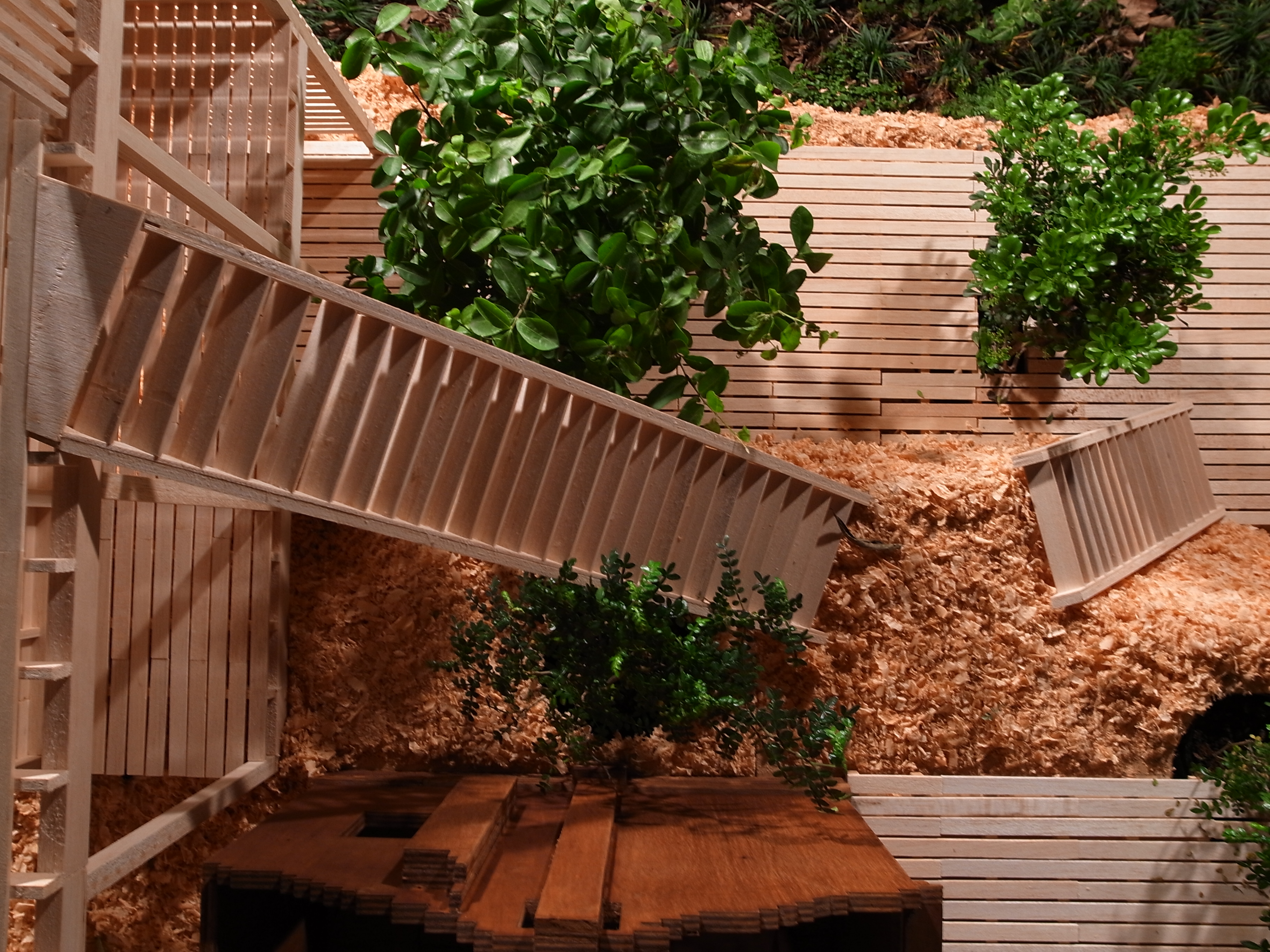
A paracity is an organic structure which can encompass a large number of human individuals. It has some things in common with our current urbanised areas however a paracity is not bound to space. It can live off a currently existing city and inhabit the same space. It can be seen as a second layer on top of a society. A paracity lives off another city like a parasite off its host. 

CLT-structure of the Paracity in Taipei.

How will a paracity affect the city it is leaching from? If you imagine an actual leech and how it sticks onto your leg and sucks from your body. Not only does it take away a resource from your body it can also pump actual parasites back into it which will harm your body. However, if you imagine it as a structure leeching onto the main city it will pull resources from the city but also provide to the city and will grow through these actions. Local knowledge can spread through the fabric and infiltrates the city. The resources it takes from the city will however depend more on what the city is able to provide rather than what the paracity wishes to take from it. This will then develop into an organic relationship providing a physical structure where a community may begin to form. The paracity would ideally be where old is combined perfectly with the new without having to be old but simply by acknowledging the old. The paracity can do this as it attaches onto it and takes from the city what is no longer desired. 


The structure of a paracity is unique in its construction method but also in the way that it chooses to move away from conventional traditional planning and architecture. It offers a personalized architectural identity in which individuals may develop their own space and transform a structure into a place. The paracity as a space is interesting similar to nature which grows around what is built a paracity will grow according to what is already present and what can be found to add onto that. Where nature may struggle a paracity will find innovative solutions to incorporate something into the structure or simply build around or on top of it. It is this biourban approach to design which allows for the development of a unique structure in which individuals will form a community. These individuals will naturally come together as they have the will to create something which is their own, which they can appropriate and share with others. In a growing society one must also consider access, provision and capacity. How will the design of a space cope with something which is completely unpredictable. The answer is found in how nature copes with growth and change in provision. The paracity has no limits which are not defined by nature itself. The paracity offers a place with new aims and thoughts. With a new system of thought we can forge a new place which creates the space for a new society to combine with what already exists and the organic growth of nature. 

Organic Paracity spreading into the surrounding industrial Taipei like a positive cancer.

The structure must offer organic growth and thereby give access to as much as it can. The structure may fold itself around what is currently present and thereby incorporate it in its design. How will individuals travel through this structure once it has become more than just a structure? The paracity seeks to be a point of play between the individual and the structure. As Foucault has said as humans we need this play to help us enhance who we are and what we deliver. This play will feed the structure as well as relationships between the individual and the structure and others living in the city. This play will form at the moment where the individual becomes a part of a greater picture, when an individual has invested in the city is the point where they will form a relationship which is constantly changing in order to accommodate others as well as the change in nature. 

Third Generation City is the organic ruin of the industrial city, an organic machine. Ruin is when man-made has become part of nature. 

A crucial aspect for the success of a paracitic society in my view depends on how quickly a society will form and the pace at which it will grow. Societies and relationships form organically over time and are dependent on the detailed design of the structure. If one would put a very large number of strangers together the chance of success at forming a society will be lower than when a group naturally forms to subsequently slowly expands. This will be dependent on the initial structure present but also on what comes readily available from the city. If there is too much available for the paracity to leech on then there will be more chance for a fast growing structure which will not accommodate the natural growth we are seeking.

Paracity primary structure at the Dashui River island in Taipei. 

A place will also depend on growing organically in order to function as a society. Places have rules and community engagement. Elders often play an important role in being in charge and enabling a community to grow around them according to unwritten rules like in Treasure hill. In a paracity it is necessary for this hierarchy to form itself in order for the rest of the society to treacle down from this in such a way that there is no room for altruism and only co-dependencies. This allows a society to grow organically mimicking natural growth. Where in nature a tree will not grow under another tree or too near another tree because they would be fighting for each others light, ground and water in society we must live according to similar innate rules whereby we prove selfless and show an interest in the well-being of others. A paracity must therefore grow according to need rather than desire. When the city needs new labour or when relationships become complicated we must envisage that new people will come and help to form a greater community. 

Farming the Paracity.

A community network often refers to an online form of community whereby individuals become linked through interest and other personality traits rather than according to location. This changes the way our day to day society works. If you think of a city no matter the scale we often do not interact with those in our close proximity. If we are lucky enough to live in an area where people spend a lot of time we may get to know some familiar faces however we still won't often reach out for help or offer help as easily as we would if we were a part of a defined community network or living in a small village where everyone knows each other. As individuals we have the innate trait to want to help others whether it be because we care or simply because it makes us feel good. This gets lost in an individualistic city where we find it more difficult to extend help to a stranger but also where there is often no one to recognise and praise your efforts. The paracity offers a solution for this which is rooted in its design. The paracity offers a communication which lies beyond the current systems whereby the city itself becomes a form of communication. Those living in the paracity will communicate through the design and what they can offer to it.

Basic 6m CLT-structural unit.
The paracity defines itself in its origin as reliant on another living structure in order to forge its existence. Without another living structure it is unable to survive. It leaches off society in order to make its own. Through this act of leeching off another society it becomes to a certain extent dependent on it. This dependency is what creates a community network in the paractiy as individuals become reliant on one another to develop this complex structure. The structure of this paracity will depend on what is readily available and how different users come together and assemble these unique pieces. It is this act of coming together which will help different users to become more assimilated with one another and begin to develop a network. This network will then create a community with co-dependencies. In such a society where we are dependent on others it is more natural for individuals to form a society where they come in aid to one another. The society will then evolve naturally according to this pattern and what nature makes available to them. It is expected that the actual structure of the paracity will play a significant role in how the community interacts and creates links between one another. Dependent on the structure and how easy it is to create links between different sections will depend on how easy it becomes to forge relationships across different sections of the design.

Formally illegal biourban settlement Treasure Hill in Taipei, Taiwan. 

Living in a close environment it becomes necessary to hold contact with one another as we are so dependent on what another individual chooses to do. How someone else chooses to expand or build their structure will directly affect those surrounding that structure. Whether it be through sound, changing of available daylight or access. All these things will come into play with the changing structure of the paracity. A strong community network will help individuals to form a social structure in which they aid one another to create a friendly more organic place to live. It is this friendly more organic structure which will then allows the community to continue to live according to paracitic rules and not to revert to the destructive ways of a traditional society.

Cover of the Paracity publication for the China Central Academy of Fine Arts CAFAM Biennale 2014.

Katie Donaghy is a biourban sociologist for Paracity / Casagrande Laboratory Center for Urban Research CURE and Programme Officer of Urban Design London.