The Ruin Academy is a kind of an open source school/research centre to re-think the industrial city and the relationship between the modern urban man and nature.
Ruin is when man-made has become part of nature. We want this to happen to the industrial city and we want this to happen for the modern man. Taipei is currently presenting the most advanced industrial co-existence of a modern city and uncontrollable organic anarchy, nature including human nature pushing through the industrial surface and tuning the whole city towards the organic. To understand this force the academic disciplines are much for no use, also the politics will provide no tools. Communication needs to find another way.
Ruin Academy has focused its research to the un-official life providing systems within the official city. These are the systems that are constantly ruining the official Taipei, systems that are composting the city. From the organic top-soil produced by these composts will emerge the Third Generation City, the organic ruin of the industrial city, an organic machine.
There are no disciplines of art or science in the Ruin Academy. Renaissance means compost – rebirth. One has to die a bit to be reborn. The smelliest parts of Taipei are containing the highest level of life still in connection with nature, while as the official industrialism aims into a sterile condition. These are the corners that will provide us the local knowledge to establish the Third Generation City.
Cross-disciplinary work is essential for the knowledge building on the way towards the 3G city. Discipline means restriction, an obstacle on your way. Disciplined people can die in masses and be numb in masses. Ruin Academy is pliant and weak as the opposite of strength and hardness. Through weakness it will challenge industrialism, modernism, science and society. The Ruin Academy is a basic shelter stripped down from industrial and academic nonsense.
So far our Taiwanese and international operators have come from the following backgrounds: architecture, landscape architecture, urban design, horticulture, journalism, construction work, art management, fine arts, sociology, journalism, river engineering, energy technology and civil and environmental engineering. Most important is the connection to the Local Knowledge, the site-specific wisdom of sustainable surviving in the Taipei Basin. This knowledge seems to be in straight connection with the First Generation City, when the built human environment was dependent on nature and dominated by nature. The Local Knowledge is a driving force for the organic penetrations through the industrial layer of the Taipei Basin today. Local Knowledge is tuning the city towards the organic.
Communication brings another level to our work. We are producing our own newspaper Anarchist Gardener as a means to articulate our thinking and findings. There is also a group of young Taiwanese journalists that are reporting on our work. Our communication centre is the public sauna on the 5th floor of the Academy building.
ZERO CITY
What are the processes that are ruining the industrial Taipei? What are the systems that are bringing life to the modern machine? (Actually Taipei looks like an old machine; not like some other Asian sophisticated centres that look like urban dildos.) What is the essence that keeps the city alive? So: where are the seeds of the Third Generation City?
1. Anarchist Gardener
- Grandmother dominated community gardens and urban farms overtaking the sleeping capitalism spots of Taipei – Organic Anarchy.
- Flexible movement to change location according to the development cycles of the city. Breaking the surface of the city and reaching the original ground.
- At some points continuing ancient farm rights and land owning inside the city.
- Often spontaneous activation of idle urban areas such as the river flood banks or land-fill areas.
- The networks of community gardens and urban farms perform organic acupuncture on the industrial tissue of the official city tuning the city towards the organic.
- The Anarchist Gardener element has been researched in co-operation with the National Taiwan University Department of Sociology.

2. Instant Taipei
- The urban nomads are using the official city as a stage or a landscape to launch independent and un-official activities for business, recreational or even religious activities.
- Citizens present spontaneous reactions through illegal architecture to customise, reorganize and dominate the built human environment. The official city is seen as a landscape to attach the illegal extensions.
- The illegal architecture can grow into illegal communities such as Treasure Hill.
- Unofficial night-markets, street vendors, under-bridge activities, karaoke spots, gambling, abandoned gods refugee centres, beetle-nut booths, Taiwanese opera, puppet theatre, tai-chi etc.
- Harvesting the city and being faster to move than the official control.
- Instant Taipei will pop up in different locations of the city in different times and is related to the energy flows of the collective mind of Taipei. People are very sensitive to feel the impulses on the shared conscious. “There is this thing going on…” a whole city can be designed by rumours.
- Roan’s Illegal Architecture exhibition is focusing on the elements of the Instant Taipei.
 Urban Acupuncture map on the wall of the Ruin Academy.
3. Urban Acupuncture
- Sensitivity to understand the energy flows of the collective “chi” beneath the visual city and reacting on the hot-spots of this chi. People feel where the city is hot, or where things are going on – what is the feeling of the city.
- Architecture is in the position to produce the acupuncture needles for the urban chi.
- On a commercial level Urban Acupuncture is practiced in Taipei by for example the highest level of 7-Eleven convenient stores in the world.
 Ruin Academy's ground floor.
4. Compost
- Taipei is constantly being composted. On official circles the composting is done by developers, who are the true urban editors and on un-official level by illegal communities and the above mentioned anarchist gardeners and illegal architects.
- In some level the hard to talk areas such as the sneak street, the red light districts and temple dominated areas are also urban compost, but somehow on the darker gangster/religious dominated side while as the collective gardens and the spontaneous independent communities are presenting a higher level of constructive anarchy in the city.
- The official Taipei has a parallel city existing on top of it and penetrating through it in order to touch the original ground. This touch-down is breaking, composting and fermenting the official city through every possible crack on the industrial surface, which tries to control and suffocate the uncontrollable organic growth. The urban compost is working against the industrial insensitivity forces the city to meet the life providing systems of the organic environment.
 Mangrove trees near Guandu enjoying the salt water tidal pulse in the Danshui River.
5. River Urbanism
- At the moment there is a 10 meters high reinforced concrete flood-wall separating the Taipei human built environment from the river. This wall needs to go.
- Ruin Academy will redesign Taipei based on free flooding and straight connection between the modern man and nature. The urban river will be naturally restored.
- The River Urbanism is developed together with the Aalto University’s SGT Sustainable Global Technologies centre and Tamkang University Department of Architecture.
 Ruin Academy, section.
Local Knowledge is theme pushing through all the elements of the 3G City, a connection between the modern man and nature.
Each of the elements are studied through a workshop, being presents in the situation and trying to interpret the findings. These fragments are then treated as the design seeds for the 3G Taipei itself.
The only problem with the current urban reality is that it is not real. Nature is the only reality.
ACADEMIC SQUATTINGI feel the universities have gone weaker the same time that the different scientific and artistic disciplines have gone stronger. Architecture stands in the crossroads of many humanistic, artistic and scientific lines. Now architecture looks like a traumatized traffic police hiding inside a concrete drum. Architects are able to communicate only with other architects. This is boring, completely unnecessary and close to nonsense. Architecture should be the one preparing on open table and public sphere for collective knowledge building, communication.
 Ruin Academy, model photo.
Ruin Academy wants to build up this table in a small scale. Ruin Academy is a meant to be a public sphere, like a pub. The academy is based on academic freedom like a circus rather than a university.
We want to rethink the industrial city and the modern man in a box. The Academy is a hole in the industrial volume; a tunnel travelling through the different layers of Taipei. People feel this tunnel and they are stepping in.
 4th floor: lounge.
There are no windows in the Ruin Academy, just holes in the walls. Also the floors are penetrated with 6 inch holes in order to let rain inside. People are working and sleeping in the dry corners or where ever on a good weather. This is academic squatting. The researchers are talking around open fire places.
We are growing bamboo on the window holes trying to keep the traffic noise outside. Bamboo and taro also gives privacy in the shower room of the sauna. There are various vegetable gardens and composts inside the building.
2. TAIPEI ORGANIC ACUPUNCTURE Acupuncture
is the procedure of inserting and manipulating needles into various points on the body to relieve pain or for therapeutic purposes.
Urban planning integrates land use planning and transportation planning to improve the built, economic and social environments of communities.
Urban design concerns the arrangement, appearance and functionality of towns and cities, and in particular the shaping and uses of urban public space.
Environmental art is art dealing with ecological issues and possibly in political, historical or social context.
Sociology is a science of human social activity.
Anarchy is acting without waiting for instructions or official permission. The root of anarchism is the single impulse to do it yourself: everything else follows from this.
Urban compost: community garden in Gongguan Taipei.
The community gardens and urban farms of Taipei are astonishing. They pop up like mushrooms on the degenerated, neglected or sleeping areas of the city, which could be referred to as urban composts.
These areas are operating outside the official urban control or the economic standard mechanisms. They are voids in the urban structure that suck in ad-hoc community actions and present a platform for anarchy through gardening.

The punctual community gardens and urban farms of Taipei. C-LAB
For the vitality of Taipei, the networks of the anarchist gardens seem to provide a positive social disorder; positive terrorism. They are tuning the industrial city towards the organic, towards accident and in this sense they are ruining the modern urbanism. They are punctual organic revolutions and the seeds of the Third Generation City, the organic ruin of the industrial city.
Corners are windy
Claude Lévi-Strauss believes in the beauty of the human nature as part of nature. Max Horkheimer and Theodor Adorno lost all the hope for the industrial development and said it has failed the promise of the Enlightment - it had corrupted humanity. Andrei Tarkovsky’s Stalker (Mosfilm, 1979) is taking sophisticated people into the Zone, where their deepest wishes may come true. The Zone which is the organic ruin mirroring the surrounding mechanical reality. For the Strugatsky brothers (Arkady & Boris) the Zone was a Roadside Picnic.

Missis Lee in the Gongguan community garden.
The community gardens of Taipei are Roadside Picnic. Grandmothers can take us there, like Stalker. The honorable Lévi-Strauss could be happy to start new ethnographical research between the parallel realities of the cultures of the urban compost gardens and the surrounding city – the reversed modernization and focusing in Local Knowledge. Horkheimers & Adorno’s graves should be moved in one of these urban acupuncture spots of Taipei. Here even they would find hope, surrounded by the valueless modernity and hard industrialism. Prof. Jaakko Hämeen-Anttila has said: “The valueless void of the society of today will be filled with ethics: the corners are windy.” With the recognition of the urban farms and community gardens Taipei has found its corners.

101 community garden in-between Taipei 101 and World Trade Center. Photo: Isis Kang.
What is the ethics then pushing through these corners into the city? It could be called Local Knowledge, site-specific reactions building a bridge between the modern man and nature. The gardens of Taipei, these acupuncture points, are penetrating through the industrial surface of the city and reaching the original ground. The self organized community gardens are the urban acupuncture needles of Taipei. Local Knowledge is in connection with the first generation city, when the built human environment was dependent on nature and regulated by nature. Now the anarchist gardeners are regulating the industrial city.
Dominate the no-man’s land
The community gardens are taking over abandoned construction sites and ruined housing areas, empty city-blocks waiting for development, flood banks of the rivers and even grave-yards out of fashion. In many cases the gardens are flourishing on spots of land where the land-owner issues are unsettle or complicated. Sometimes the garden will stay in the spot for only a couple of years, as in the cases of soon to be developed areas and sometimes the urban farming has decades long traditions as with the river flood plains or on the island in-between Zhongxiao and Zhongshing bridges. The smaller urban farms are flexible and eager to overtake the empty spots of the city, eager to dominate the no-man’s land.

Treasure Hill in 2003. Photo: Stephen Wilde.
One of the more famous urban farming communities of Taipei was the Treasure Hill settlement, originally an illegal community of KMT veterans. During its legitimating process Treasure Hill became so famous that eventually the original community was kicked away by the city government and the houses were taken over by artists and art related organizations. All the farms were destroyed on the process. Sounds like urban warfare against urban acupuncture. Treasure Hill was powerful and self-sustained when it was illegal. The community built its own houses and its own farms and it made its own rules. The official city wanted to eliminate this unofficial organic rival. NGOs found the issue sexy and stepped in to protect and legitimize the settlement. In the end the NGOs and artists took over the now-famous community and hooked up with the city government. The original urban farmers didn’t fit the picture anymore and had to leave. Now you can listen gansta-rap in a yellow plastic tent where the gardens used to be. Local knowledge died.

Missis Chen, the leader of the Treasure Hill urban farming community.
But Treasure Hill is not alone. Urban farming happens through different social classes and through out the city. The socially disordered citizens are ready to occupy land and start the community farms over and over again. Some acupuncture spots get hot and benefit the surrounding urban tissue while others fade away. The industrial surface of the city keeps constantly being broken up and herbs and vegetables are planted into the cracks. People are ruining the industrial city. Ruin is when man-made has become part of nature.
Urban Editors
Compared to Western cities Taipei plays in quite different rules. The aesthetics of the city is dominated by the functionality of a big collective machine and the urban mechanism is constantly being edited and rendered as with changing the micro-chips or other parts of a super-computer into more powerful ones. The urban data is people and this is what the machine needs to process. Mostly it goes smoothly, but also people get viruses – they get together to spontaneous demonstrations, they do tai-chi in improvised city-corners, they launch ad-hoc night markets or under-bridge sales on temporarily occupied streets or city corners. And they do farms – they are squeezing organic material into the machine like a creeper crawling into an air-conditioning box. Why they do this? Why does the nature want to break the machine?

Hyena Man. Photo: Pieter Hugo
Developers are the true urban editors. They are linked with the city authorities and necessary political powers and they make the urban editing. Architects are in a secondary role – something like the hyenas after the lions have made the kill. Money is a good consultant and the generating force of the developer run urban editing process. This is not urban acupuncture though; it is more like a western style medical practice – operations on the body removing, changing or maintaining parts – or even plastic surgery. (Oh, Shanghai has bigger tits than Taipei.) The body is not necessarily seen as one big organism.

In this rough editing process the anarchist gardeners seem to act as micro-editors, parasites benefiting of the slow circles of the big-scale development. They occupy the not so sexy areas of the city and they jump in the more sleepy parts of the development cycle. For example – the developer buys a whole city block with originally many land-owners. The process is slow because he has to negotiate with all of them. While the process is dragging behind the urban farmers step in and start farming the area. The developer doesn’t want to cause any more fuss and let it happen. It takes 3-5 years before the developer has got all the area to his possession and those same years the site acts as the community garden. When the actual construction starts the gardeners have already occupied a next vacant spot in the city.
Third Generation City
First generation city was the human settlement in straight connection with nature and dependent on nature. The fertile and rich Taipei basing provided a fruitful environment for such a settlement. The rivers were full of fish and good for transportation and the mountains protected the farmed plains from the straightest hits of the frequent typhoons.
 Taipei Basin - a river valley surrounded by mountains on three sides and opening up to the Pacific Ocean.
The second generation city is the industrial city. Industrialism claimed the citizens independence from nature – a mechanical environment could provide human everything needed. Nature was seen as something un-necessary or as something hostile – it was walled away from the mechanical reality.

Third Generation City is the organic ruin of the industrial city. The community gardens of Taipei are fragments of the third generation urbanism when they exist together with the industrial surroundings. Local Knowledge is present in the city and this is where Ruin Academy focuses its research. Among the urban gardeners are the local knowledge professors of Taipei. Third Generation City is true when the city recognizes its local knowledge and allows itself to be part of nature.
3. ILLEGAL ARCHITECTUREMy first assignment in Taipei was to work with illegal architecture trying to save the Treasure Hill community. This was also the first time that we worked together with Hsieh Ying-Chun and Roan Ching-Yueh for construction. Actually with Hsieh for construction and Roan arranging everything, as usual. We had met earlier at the Urban Flashes in Linz, where Roan moderated our talks, so we were “aware” of each other. In Treasure Hill I didn’t have any other common language to talk with Hsieh or the original community than physical labour – architecture through spontaneous construction. Hsieh started to build up on the hill and I started from the bottom. We sensed each other’s actions and could make instant reactions of them, communicate and improvise. At some point we met. This is Open Form.
 Hsieh Ying-Chun's illegal architecture rising up on a back alley of the Urban Core (JUT) area of Taipei.
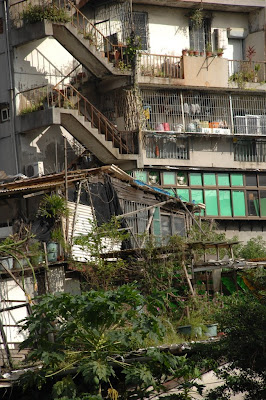
Taipei is Open Form. Citizen design reactions communicating with each other and trying to dominate the no-man’s land like different plants in the jungle. Hsieh takes his commands from the jungle. So does the Taiwanese citizen built illegal architecture. This architecture uses the “official” city as a growing platform and energy source, where to attach itself like a parasite and from where to leach the electricity and water. The layer of illegal architecture combined with other citizen activated spontaneous community reactions such as the illegal urban farms or night markets is so widespread and deep rooted in the Taiwanese culture and cityscape that we could almost speak of another city on top of the “official” Taipei, a parallel city – or a para-city: Instant Taipei.
 Wang-Su's illegal architecture on the roof of the Urban Core cafe.ORCHID ARCHITECTURE
Illegal architecture is Weak Architecture. One tries to achieve the maximum effect with minimal effort. This architecture is as sharp as it is lazy. This architecture has personality and nature and it can disappear as fast as it has blossomed – like an orchid. The official, stiff, hard and boring Taipei is blossoming with Orchid Architecture. The illegal citizen activities are keeping the city alive, they are ruining the faceless industrial city and pushing in the organic.
 Hsieh getting a bit romantic.
Illegal architecture comes in many forms. You have the horizontal and vertical illegal extensions of the apartment buildings, illegal houses and illegal communities such as Treasure Hill or the Amis urban village by the Xindian River, pigeon houses, beetle-nut booths, temples and even moving architecture like the Taiwanese street-style operas or night-market booths. The point is that this fruitful culture of self-made architecture has only been illegal as long as the “official” city has been in the picture. These flexible, moving, adjustable and pliant forms of urban nomad structures have always been. Official city is the newcomer. Illegal architecture is a new name for the citizen’s right to express himself through architecture. These guys don’t need architects, they are the architects themselves. They are more resourceful and creative that the “official” architects corrupted by the university teaching, building industry and laws and codes of construction.
 Power installation at Treasure Hill.
Official city wants to get rid of anything spontaneous coming straight from the human nature. This means “illegal” architecture and “illegal” gardens in the urban stage instead of self-made home and growing of food. Industrial city is a machine designed to regulate human life. Illegal architecture is closer to nature including human nature and so against any kind of control.
Hsieh calls his style People’s Architecture. Basically this means giving power back to people to build their homes and to self arrange their communities. This is needed in the countryside but also especially in the industrial city. Hsieh wants people learn again to tune their built human environment to the natural conditions, hook up to the site-specific Local Knowledge and experience the architectural landscape through physical labour. Hsieh wants people to regulate their own built human environment out of official control. Before industrialism and before modernism this has been normal. Now the official city wants to “beatify” the streets from humane architecture, which has become a human error in the official data.
 Bug Dome at the Shenzhen - Hong Kong Biennale 2009. WEAK!WEAK!
Hsieh, Roan and me form a loose co-operative and we call ourselves the WEAK! In Shenzhen 2009 we build an un-official social club for illegal workers coming from the Chinese countryside to the city. This small pavilion was constructed mainly by some very sensitive guys from rural Guangxi, true masters of bamboo. The Bug Dome is insect architecture merely reorganizing natural materials into a nest or cocoon. The contrast to the surrounding skyscrapers of modern Shenzen is shocking. None of the Local Knowledge is accepted in the fast growing city. All the natural wisdom that the hundreds of millions of hands moving now from the Chinese countryside to cities is ignored. If this volume of Local Knowledge that is now pouring into the Chinese cities would be recognized, the new Chinese urbanism would have a change to create something seriously new and environmentally sustainable.
 Hsieh Ying-Chun, left and Wang-Su - illegal architects.
Wang-Su is an architectural insect. He has recognized the element of Local Knowledge in the new urban construction workers and he is using this sensitivity as the essence of his architecture. Wang-Su is balancing on the razors edge in-between control and accident and he is pushing the architectural articulation to meet the common man, like Hsieh. Crawling, slithering and still surviving... (Coppola: Apocalypse NOW!) In the Ningbo Historic Museum Wang-Su is building archaeology. The new building is impregnated with memories, subconscious moves and aura that only human presence can transform into a house. Wang-Su has required the construction workers to improvise within the bigger voice of architectural landscape – a bit the same way as Hsieh with the Sichuan tribes. The outcome is a fruitful mixture of simultaneous architectural control and the breaking of it. The great element of accident is present and this time it is harmoniously talking with the architectural control. Wang-Su’s museum is a constructed ruin, an ultra-ruin breaking far away from the modernist clichés and the shiny steel and glass surfaces of the new Chinese cities.
 Wang-Su's cocoon seen from the C-LAB balcony.
Roan wanted to hook up Wang-Su with Hsieh and me. He says this is the way how the WEAK! works – we invite people to be weak together. Wang-Su has now built a cocoon on the roof of the Urban Core cafe and Hsieh has grown his architectural creeper structures into the narrow back alleys rooting in the Ruin Academy. Wang-Su has made his cocoon out of wooden sticks, but he hasn’t used any nails. His understanding of three dimensional tension is on the level of the insects. Hsieh has found the fruitful top-soil of the Ruin Academy and he has exploded through the windows and bathrooms to blossom in the space up in the air in-between the buildings. Both Wang-Su and Hsieh have more air in their buildings than structure. Their works are mediators between the modern urban man and something else, that they know exists on the horizon. What comes to Ruin Academy, we can feel that horizon too.
 Wooden architecture without nails.INSTANT TAIPEI
Taipei should be careful with its steps towards a “beautified” future. If the official beauty means killing the self regulated urban communities, destroying the urban farms and community gardens, cleaning the roof-tops out of pigeon houses and illegal architecture and forbidding people to: swim, barbeque, walk a dog, step on grass, chewing of beetle-nuts, fly kites, fish, street vending, karaoke, gambling, picking flowers, sleeping and picnics ... what is left? Beautified official boredom with a polluted river.
 No human error.
Instant Taipei happens when there is air to move, like in Wang-Su’s and Hsieh’s architecture. Space for Instant Taipei is the whole city; space where human nature can endlessly construct and deconstruct like ants in human scale. The official city can happen simultaneously together with the Instant Taipei and the official city should accept this as something really beautiful. Let the city rotten, ferment and compost itself. Recognize the illegal architecture as the true force of Taiwanese architecture.
---
The NTU Sociology Department's public lecture and the cross-disciplinary compost city thinking is developed in a dialogue with Professor Yen-Fen Tseng, to whom I express my sincere appriciation.The Ruin Academy research is kindly supported by the JUT Foundation for Arts & Architecture. 

 Paracity supplies
a growth medium for the development of the community framework to which people
add their own human elements. Design does not seek to replace reality. Flesh is
More. The primary structure consists of a grid of six or three-meter long
glue-laminated beams with CLT panels serving as bracing. The beams are
inter-connected using wood joints making it possible for people to extend the
primary framework as they wish. CLT possesses excellent earthquake and
fire-resistance properties.

 In the Paracity
pilot project we have proposed in Taipei, household and irrigation water is
drawn from the polluted local river and purified. Pre-purified water is pumped
to the roof terraces where it is oxidised and root-purified by plants selected
for this purpose. From the green areas on the roofs, the water flows down to
the community gardens and urban cultivations. Paracity’s main source of energy
is the fast-growing biomass that thrives on the fertile flood lands along the
river.

 The fragments
of Paracity scattered around Taipei form a network of urban architecture that
steers industrial development towards an organic machine. By ruining the
industrialised city, it seeks to reclaim it to become part of nature and a
‘third-generation city’.

 The
second-generation city is an industrial city, seemingly independent from the
natural environment surrounding it. In fact, nature seems to be harmful to this
mechanical machine, as if the floods, for example, intend to destroy it. To
prevent this, Taipei has built the flood wall.

 Urban acupuncture is a theory of ecological urban
planning that seeks to combine urban planning with the ideas of traditional
Chinese medicine. Fundamentally, it perceives cities as multi-tiered living organisms and tries to identify areas and districts ripe for an
upgrade and reconditioning. Projects relying on the local traditions and based on the principles of
sustainable development serve as acupuncture
needles that stimulate the entire organism by curing parts of it.

 Paracity is the
seed of a third-generation city. A modular biourban organism grows in response
to human needs while at the same time ruining the surrounding industrial city.
Seeds of Paracity are germinating within Taipei in the collective gardens,
illegal settlements, abandoned burial grounds and other undeveloped sites.
These seeds will contribute to the biological rehabilitation of the surrounding
city through urban acupuncture. From these points, Paracity will spread out
along the covered river and irrigation channels. Ultimately, the biourban
organism and the static city will reach a biologically sustainable equilibrium
that will give birth to the third-generation city. ark


