Il film Zero City del laboratorio di Marco Casagrande illustra alcuni dei temi forti del suo pensiero sulla transizione dalla città industriale e postindustriale all'urbanesimo "di terza generazione": la marginalità resiliente della vita, rappresentata dall'erba selvatica che spunta fra le crepe dell'asfalto, dal fenomeno degli orti illegali che gli abitanti delle megalopoli realizzano spaccando il cemento di un'urbanistica ormai incontrollabile, dalle presenze animali e vegetali in ambienti che sono ad essi cognitivamente refrattari; l'irrilevanza dei due pilastri della antisocietà urbana che ci stiamo già lasciando alle spalle, l'immagine e il cemento; la necessità per l'uomo - il grande assente fra la natura e la tecnica - di tacersi serenamente, umilmente, per ascoltare la pulsazione della vita. Fenomenologia della biourbanistica in atto.
Tuesday, February 18, 2014

Monday, February 10, 2014
TURKULAISARKKITEHTI SAI TILAUKSEN PAKISTANISTA
Turun Sanomat, Islamabad
Pia Heikkilä

Itsemurhapommeja, talibanien hyökkäyksiä ja julmia heimosotia. Pakistanin uutisotsikot kertovat omaa karua kieltään. Mutta on olemassa toisenlainen Pakistan; nopeasti kasvava ja ulkomaisille investoinneille avoin maa, jossa ihmiset ovat aidon kiinnostuneita suomalaisesta muotoilusta ja ympäristöosaamisesta.
Tämä Pakistan kiinnostaa myös turkulaissyntyistä arkkitehtiä Marco Casagrandea.
- Ei yhtään pelota tulla tänne, päinvastoin, Pakistan on hurjan kiinnostava maa ja asiat on täällä hyvin järjestetty, Casagrande sanoo.
Casagrande on Islamabadissa toista kertaa, tällä reissulla allekirjoittamassa sopimusta Pakistanin teknologiayliopiston NUST:n kanssa tiede ja teknologiapuiston suunnittelusta.
Kyseessä on merkittävä sopimus Casagrandelle ja turkulaiselle partneriarkkitehtitoimisto Haromalle. Projekti on päänavaus suomalaiselle suunnittelulle Pakistanissa ja se tulee toimimaan suomalaisen ympäristöteknologian työnnäytteenä Etelä-Aasiassa.
- Pakistanin valtion rahoittama projekti tehdään kokonaan suomalaisesta puumateriaalista, koska ympäristöystävällisyys oli yksi tärkeitä vaatimuksia, Casagrande kertoo.
Pakistanin valtiolle on tärkeää, että projektin toimittaja on tunnettu cleantech-osaamisestaan.
- Pieni Suomi on cleantechin suurvalta ja meillä on tällä alalla paljon vientipotentiaalia, Casagrande uskoo.
Rakennusmateriaalina tullaan käyttämään laminoitua puuelementtiä, joka toimitetaan Suomesta. Rakennukset pystytetään eri paikallisten toimijoiden voimin.
- Viemme Pakistaniin projektin mukana myös vihreän rakentamisen tietotaitoa ja koulutamme rakentajat projektin yhteydessä, hän sanoo.
MAANJÄRISTYSTÄ KESTÄVÄÄ PUUTA
Pakistaniin vietävä puu on Casagranden mukaan maanjäristystä kestävä ja soveltuu hyvin Pakistanin vaativaan ilmanalaan. Lisäksi suomalainen puuteknologia on maailman huippuluokkaa.
- Olen positiivisesti yllättynyt, että pakistanilaiset haluavat ottaa rohkean askeleen vihreämpään rakentamiseen.
Kyseessä on mittava projekti, joka valmistuu viiden vuoden kuluessa. Casagrande kumppaneineen kasvaa Aasiassa vauhdilla, sillä suomalaiselle arkkitehtiosaamiselle on maailmalla kysyntää.
Yritys esittelee vielä tässä kuussa Kiinassa kokonaista kaupunkisuunnitteluprojektia, joka perustuu kestävään suunnitteluun.
Casagrande pakkaa Islamabadissa laukkujaan jo seuraavalle lennolle suuntanaan Dubai ja sieltä matka jatkuu edelleen Amerikkaan.
Friday, February 7, 2014
Il Prof. Marco Casagrande (Finlandia) nominato vicepresidente della International Society of Biourbanism

Lo European Prize per l'architettura del 2013, fondatore della Ruin Academy e del C-LAB, Marco Casagrande è un architetto rivoluzionario oltre che un teorico sociale che mira a riportare autenticità umana all'urbanistica, all'architettura e all'arte. La sua agopuntura biourbana è diventata un innovativo approccio all'urbanistica con azioni concrete co-generate nel più profondo tessuto sociale di una città. Ha operato, esposto ed insegnato in diversi Paesi: Finlandia (Università di Helsinky), Italia (Biennale di Venezia, scuola di ISB in neuroergonomia), Austria (MAK, Vienna), Taiwan (Tamkang University), USA (Alaska Design Forum), ecc. Il suo ultimo libro è Biourban acupuncture. Treasure Hill of Taipei to Artena, ISB 2013.
Fondata nel 2010, la Società Internazionale di Biourbanistica è un'innovativa rete interdisciplinare di studiosi impegnati a redigere un nuovo paradigma nella pratica costruttiva e negli studi urbani. Essa si concentra sul ruolo svolto dalle leggi naturali sulle forme, sulle leggi della forma e sul contributo che la complessità e la teoria dei sistemi possono offrire alla pianificazione della città. E' intenta a plasmare un design basato su un criterio umano-centrico attraverso lo studio della biofilia e della neuroergonomia. Esplora nuove pratiche costruttive e metodologie progettuali come l'agopuntura biourbana e il p2p urbanism.
Marco Casagrande collabora con l'ISB fin dalla sua fondazione con pubblicazioni e dibattiti. Nel 2013 ha insegnato alla ISB Summer School in Neuroergonomia e Urban Placemaking, ha pubblicato il suo libro "Biourban agopuncture. Treasure Hill of Taipei to Artena" con l'ISB e fonda sempre con la ISB la sede italiana della Ruin Academy ad Artena, Roma.
Il direttivo ISB ha proposto Marco Casagrande come vicepresidente durante la campagna di rinnovo dei ruoli nel gennaio 2014. I membri internazionali lo hanno eletto all'unanimità.
Marco Casagrande appointed Vice-President of the ISB
[PRESS RELEASE]

European Prize for Architecture 2013, founder of the Ruin Academy and of the C-LAB, Marco Casagrande is an innovative architect and social thinker who aims at bringing human authenticity back to urbanism, architecture, and art. His biourban acupuncture has become a revolutionary bottom-up and p2p approach to urban planning. He has worked, exhibited, and taught in several countries: Finland (Helsinki University), Italy (Biennale di Venezia, ISB School in Neuroergonomics), Austria (MAK, Vienna), Taiwan (Tamkang University), USA (Alaska Design Forum), etc. His latest book is Biourban Acupuncture. From Treasure Hill to Artena, ISB 2013.
Established in 2010, the International Society of Biourbanism is a worldwide innovative network of interdisciplinary scholars involved in establishing a new paradigm in urban studies and practice. It focuses on the role played by natural laws on forms, on the laws of form, and on the contribution that complexity and systems theory may offer to city planning. It works on the basis of a human-centred design process, tapping into biophilia and neuroergonomics. It explores new building and planning methodologies, such as biourban acupuncture and p2p urbanism.
Marco Casagrande has been collaborating with the ISB since its foundation with publications and discussions. In 2013, he taught at the ISB Summer School on Neuroergonomics and Urban Placemaking, published his book Biourban Acupuncture. From Treasure Hill to Artena with the ISB, and founded the Italian branch of the Ruin Academy in Artena, Italy, together with the ISB.
The ISB board proposed Marco Casagrande as Vice-President during the society’s selection campaign in January 2014. He was elected after an unanimous vote by members from several countries.
Saturday, January 25, 2014
CE N'EST PAS UNE MAISON PASSIVE, C'EST UN VAISSEAU ACTIF
AUTEUR LISE BERTRON
PHOTOS ADDA ZEI / écomaison BOIS JANVIER FEVRIER 2014
Son
architecte Marco Casagrande en parle comme d’une personne, en la
prénommant Apelle. Cette maison, située
a Karjaa au sud de la Finlande au sommet d’une crête glaciaire, est construite
comme un bateau, dans un port naturel entoure de rochers et d’arbres.
 |
| LUMINEUSE. Apelle est orientée vers la foret et légèrement inclinée vers le sud-ouest pour que le soleil soit dans son axe en permanence, jusqu’au crépuscule. Le grand débord de toit la protège des rayons du sud les plus forts. |
Son
architecte Marco Casagrande en parle comme d’une personne, en la
prénommant Apelle. Cette maison, située
a Karjaa au sud de la Finlande au sommet d’une crête glaciaire, est construite
comme un bateau, dans un port naturel entoure de rochers et d’arbres.
 |
| MAQUETTE. La forme en tube de la maison s’est imposée en fonction des conditions naturelles alentours – les arbres, les rochers, les vents forts et la couse du soleil. |
 |
HUBLOTS. Les trois fenêtres circulaires sur la façade fort allusion a des belvédères de navires sur la mer. Le blanc est un faire/valoir de la nature. |
 |
| VOLUME BIS. Le long de ce tube principal, un second volume supporte la bâtiment principal, agissant comme un balancier. Cet espace sépare permet de conserver des moments d’intimité et c’est surtout un repère pour l’écrivain de la maison. |
 |
| TOUS LES BOIS, SONT PEINTS EN BLANC A L’INTERIEUR, AVEC LES PEINTURES ECOLOGIQUES TIKKURILA. Marco Casagrande a dessine la cuisine et l’a conçue en Corian, dans des mesures restreintes comme dans un bateau, fonctionnelle avant tout. Elle a été fabriquée par Domus, en Finlande. |
Apelle a été
construite pour une famille avec trois enfants, par deux charpentiers locaux en
bois. « Selon eux … c’est un bateau ! », s’amuse l’architecte
Marco Casagrande qui l’a imaginée. De par sa forme d’abord, et surtout parce
qu’elle a su se glisser sur le site sans le dénaturer, sans souffler aucune
roche et sans nécessite de travaux de fondations lourdes. L’architecture s’est révélée
a elle-même. « Pour moi, cette maison est avant tout un instrument environnemental.
Elle rend possible la connexion entre l’homme moderne et la nature – je vois
l’architecture comme un médiateur entre les éléments. »
La famille
navigue au quotidien dans une unité de vie multifonctionnelle
(traditionnellement appelee Tupa ou Pirtti en Finland) qui reste en constante
connexion étroite avec la réalité de la nature. La maison se déroule en un tube
continu , aboutissant sur une terrasse au cœur de la foret. Le long de cet axe,
sont organises les espaces relatifs aux activités collectives et privées de la journée ;
dans le même espace décloisonne de 110 m2, chaque membre de la famille peut
dormir, manger, et être ensemble, travailler ou faire de la gym … Cependant, il
est possible d’isoler occasionnellement une chambre d’amis dan la chambre loft au-dessus
du cube de la salle de bains, ou un bureau dans le petit volume de 10 m2
attenant a la maison, relie a une terrasse couverte de 20 m2.
 |
| SALON. L’architecte : « Au-delà de la maison elle-même, j’ai dessine tous les meubles moi-même sur-mesure. Les chaises et la table a manger ont été construites par Mirella Peltonen comme des prototypes pour une éventuelle production de masse. La cousine et les machines a laver son signées Smeg. » |
 |
| LONGILIGNE. L’intérieur, comme l’extérieur, est barde en pose horizontale, soulignant la longueur de la maison – 23 mètres de long pour 5 a 7 mètres de large. Au fond, un cube camoufle la salle d’eau, et a permis l’installation d’un loft-dortoir au-dessus. |
Derrière le cube
central, la chambre se déploie dans la continuité de la pièce de vie. De
manière générale il n’y a « aucun mur intérieur dans Apelle. »
 |
| Poêle. Comme un mat structurel sur le pont d’un bateau, le poêle en métal blanc traditionnel Pönttöuuni sert de división entre le lit et le reste de la pièce. La neige renvoie largement la lumière dans la maison. |

Pour sa construction,
uniquement deux essences de bois ont été utilisées : du pin finlandais et
de l’épicéa – tout comme les arbres aux alentours. « C’est un matériau de
construction naturel en Finlande, il l’a toujours été et le sera toujours,
reprend Marco Casagrande. Je constate d’ailleurs avec grand plaisir que la
plupart des résidences secondaire finlandaises sont de simples chalets de bois
rustiques, preuve de l’attachement de la plupart des familles a nos valeurs traditionnelles.
« La fibre de bois, produit écologique de haute qualité environnementale,
est également utilisée comme isolant ; et aucune matière plastique n’est présent
dans la structure. Le chauffage est géothermique avec 150 mètres de circuit
enterre au sol, et deux cheminées en renfort pour les hivers les plus rudes.
Ainsi, Apelle bénéficie d’une excellente isolation et d’un confort optimal malgré
la neige et le vent. « Ce n’est pas une maison passive, c’est un vaisseau spatial
indépendant et actif ! », affirme Marco Casagrande. D’ailleurs,
l’espace est littéralement active par la nature environnante et par la lumière
du soleil ou de la lune : la foret agit comme un refuge pour abriter la
maison, et la maison est dans la foret autant que la foret est dan la
maison. »
Un an de
conception et une autre de construction … Apelle a pris le large grâce a une
équipe soudée qui a su dialoguer et ressentir l’essence même de cette maison
des le début du projet, « et surtout de protéger son âme tout au long du
process de construction. »
 |
| RANGEMENTS. La maison est fonctionnelle avant tout et a été pensée des le début dans sa globalité, jusqu’aux finitions. |
 |
| IMMERSION. Un coup d’œil sur la nature comme dans un aquarium. Pour l’observer sous des angles nouveaux. |
 |
| Toit vitre. « Nous avons privilégie avant tout la lumière naturelle, c’est une question architecturale fondamentale. « Les grands pins protègent cependant des rayons les plus chauds. |
 |
| Ouvertures (d’esprit). Entre les deux volumes, un toit en verre s’ouvre vers la cime des arbres entourant la maison. Cet axe vertical équilibre l’axe horizontal principal de la maison. |
 |
| Dans le cube central, est camouflée la pièce d’eau, véritable petit coin de paradis. Et si le sauna est une institution en Finlande, Apelle n’en continent pas … parce que les grands-parents vivent juste à coté et que la famille se réunit dans le leur ! |
 |
| Plaine nature. En Finlande, les hivers sont longs, sombres et froids. Les 4 saisons conditionnent constamment l’atmosphère à l’intérieur de la maison. |
 |
| Construction sur-mesure. Rien n’est préfabriqué, toute la maison est construite sur site par principalement deux maitres-charpentiers : Jens Nylund et Ingolf Westerholm avec le questionnaire de site Bengt Öhmann / LU-Rakennus qui a réalise les rêves les plus fous de l’architecte. |
 |
| Cette aurore boréale magnifie Apelle, qui reflète superbement toutes les lumières exceptionnelles de la Finlande. Le paysage est magique et inspirant. |
 |
| Oasis du nord. Dans la nuit noire et froide, Apelle est un refuge chaud et lumineux. |
Architecte :
Marco Casagrande, avec Nikita Wu, Jan Luksic, Shreya Nagrath, Arijit Sen
Constructeur :
Bengt Öhman / LU-Rakennus
Maitres Charpentiers :
Ingolf Westerholm, Jens Nylund
Designer Mobilier :
Marco Casagrande
Anneé de construction:
2013
Surface habitable:
140 m2 + 80 m2 de terrasses
Sunday, January 5, 2014
STANDING IN THE TIDES
Sculptures provide homes for tiny ocean residents

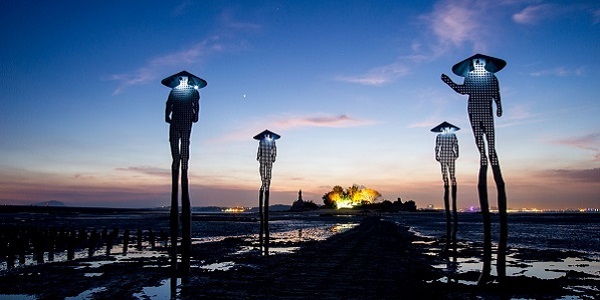
The island of Kinmen, Taiwan - where oyster cultivation is a long-standing tradition - was the final flashpoint of the Chinese Civil War in 1949. More recently, Finnish environmental artist and architect Marco Casagrande noticed that rusted steel anti-landing poles still standing in the waters around the island are covered in oysters - and that filled him with hope. "Even the war tectonics can be taken over by nature and transformed in to life-providing systems," he says.
When creating Oystermen, part of the Floating Islands art festival project at the Shanghai Bienniale, Casagrande was further inspired by the long reflections of oyster farmers' legs in the water. The permanent installation consists of four towering stainless steel sentinels, who stand six meters tall along an ocean road at low tide.
When the tide rises, the trail connecting Greater Kinmen to a smaller island disappears under the ocean's watery embrace, as does half of the sculpture. At high tide the Oystermen - whose conical hats are covered in solar panels that power LEDs underneath at night - appear to stand on the water's surface. Over time, oysters will envelop their submerged legs, creating artificial reef.

Friday, December 27, 2013
INSECT ARCHITECT
Mia Zhang interviewing Marco Casagrande
PRO.DESIGN 01/2014
ISBN 978-988-12438-8-1
 |
| Cicada, Taipei |
Pro. Design: What inspired you to get into architecture?
Marco Casagrande (Marco for short): I have always been drawing, playing in forest, building snow cave systems and imagining my own worlds, telling stories to myself. I didn't choose architecture, I just ended up there.
Pro. Design: What would you prefer to be called, architect, environmental artist, or social theorist?
Marco: I would like to be called something that combines all of those three. Maybe Constructor or Insect.

Marco: I enjoy this kind of construction, where the building parts are human scale - fits a hand and the structure can be woven up together by small scale repetitions, like insect architecture. I got very curious about insects when fixing up a Fujian style brick roof in T-Factory, Sanjhih, North-Taiwan and a bee came to steal my cement from my red bucket. This big bee kept coming back and I wondered what he did with the cement --- could he digest it? (I had mixed some lime and sea-weed into the cement for flexibility.) After a couple of months I found the cocoon of the bee in the downstairs of our living ruin. He had mixed the concrete with mud and pieces of straw and wood in order to create a fantastic dome structure with natural ventilation for his offspring, which had flown away. I documented this cocoon and started imagining humans in insect scale and building these kinds of cocoons and other insect architecture strictly tied with nature for us modern men as industrial insects.
 |
| Wasp cocoon made out of weak concrete. |
Marco: There is no limitation for inspiration. Limitation is a different thing. Life is unlimited inspiration. Inspiration is kind of a thought originating from nature, the life-providing system. This system is one big brain and if you connect with it, you are inspired. Nature thinks through you.
Pro. Design: I saw a picture of you carrying stones during the construction of Bug Dome project in Shenzhen City. Are you always engaged yourself in the whole construction process?
Marco: Being present is the key of all art. It is a blessing, not a burden. Architecture is not a remote control art, but it requires humane presence. I must be there in order to understand, what the architecture is trying to transmit, what it needs to become. I am a simple architect, not a fortune-teller…I need to be there.

Pro. Design: Your studio name is Casagrande lab. I mean, Casagrande is your name, of course, but why “lab”? Is experimentation your major focus? Then what do you experimenting on?
We are working more like a laboratory than an office. All our work is project based and cross-disciplinary. Sometimes, when we are really good, you could call us a circus. Art is a constant experiment by its nature. Also the deepest nature of architecture is the unknown.


Pro. Design: You used a lot of willow. I have seen willow woven objects like basket. They are adorable, and because they are small they don’t seem to contrast drastically to the modern world. But a large project, like Cicada in Taipei, would contrast a lot to the surrounding, at least to me. So how do you see that contrast?
Marco: Mixed feelings. It shows how brutal the surrounding city is, but same time offers an escape or retreat to the modern man. In some sense this kind of insect architecture is acting as a mediator between the modern man and nature. You can also see how totally the modern city is lacking local knowledge.

Marco: No trends, no style – just architecture. Later, when the transformation is almost complete, my way is insect architecture.
Pro. Design: What do you enjoy most in your work?
Marco: Seeing the unknown, forgotten and neglected. I enjoy the feeling of freedom and clarity, when you are truly working, when architecture is near.
Pro. Design: What do you think is the most important quality of an architect?
Marco: There are different ways, not only one. Some architects have the capacity of being a design shaman, interpreting what the bigger nature of collective mind or shared conscious if transmitting. This shamanism is close to nature.
 |
| Chen House, Sanjhih, Taiwan |
Marco: Constructing human environment as a mediator between man and nature. This can be both practical and spiritual.
Pro. Design: What do you think of the current situation of architecture?
Marco: Boring. Modern architecture is dominated by industrialism and tries to compensate this trauma by flashy images and computer generated mutations. Architecture has become pornography for architects and kinky architecture hangs around politicians and businessmen, who get pleasure in dominating an architect to make their twisted orders come true. In this situation architect is a prostitute, which becomes boring after a while. We really have to focus on local knowledge and the possibilities of bio-urbanism together with normal people and get rid of the power-architecture.
 |
| Ruin Academy in Artena, Italy |
Marco: I am setting up NOMAD - an environmental art and architecture school with architect Hans-Petter Bjørnådal in Hemnes, Norway and I am setting up Ruin Academy with architects Roan Ching-Yueh and Hsieh Ying-Chun in Taipei and with the International Society of Biourbanism in Artena, Italy. I am starting to design a new wooden house in Taidong, South-Taiwan. This house will be floating in jungle.
Pro. Design: I saw you quoted Bertolt Brecht “In a dream last night, I saw a great storm. It seized the scaffolding….” So you read a lot of Bertolt Brecht? Which of his book is your favourite? What other writers do you like?
Marco: I like Brecht poems. They are good for hang-over.
Joseph Conrad: Heart of Darkness
Arkady and Boris Strugatsky: Roadside Picnic
Adorno & Horkheimer: Dialectics of Enlightment
Burgess: A Clockwork Organge
Claude Levi-Straus: The Savage Mind
Beckett: Waiting for Godot
Lao Tzu: Dao Te Qing
Kropotkin: The Spirit of Revolt
Kalevala
Tolstoy: War and Peace
But movies are equally important:
Tarkovsky: Stalker
Francis Ford Coppola: Apocalypse NOW!
Fritz Lang: Metropolis
Kubrick: 2001: A Space Odyssey
Eisenstein: Ivan the Terrible
Bergman: 7th Seal
Kurozawa: Dersu Uzala
Herzog: Fata Morgana
Kaurismäki: Man Withouth Past
Schlöndorff: The Tin Drum

Pro. Design: What do you believe in?
Marco: Life / Nature, Accident
Pro. Design: Is there any difference between the working you and the not working you?
Marco: I am in the ruins, in the cross-roads, on river banks and garbage dumps. The office-me is nothing of this, but I am constantly aware of it and constantly escape to the jungle.
Pro. Design: What kind of lifestyle do you prefer?
Marco: Real Reality.

Marco: Fishing. Boxing. Drinking. Sauna. Play with kids. Enduro. Watch movies. Pick mushrooms.
Pro. Design: Do you like music? What is your favorite musician?
Marco: Right now I enjoy to dance Greek Zorbas with my 9 months old son.
Pro. Design: You have to expose yourself in nature so as to get inspired. But getting close to nature always reminds me of being wild and adventurous. Would the birth of your son change your way of approaching nature? Would you take a more reserved way?
Marco: Nature is about energy exchange. you have to input some of your own energy in order to receive reality. Other than that is just viewing of nature, which is kind of a fiction. Real nature demands your energy. Flesh is more. My son will not be "protected" from nature; on the contrary, the whole family will be fully sacrificed to nature. One has to die a bit to be re-born.
Marco: Nature is about energy exchange. you have to input some of your own energy in order to receive reality. Other than that is just viewing of nature, which is kind of a fiction. Real nature demands your energy. Flesh is more. My son will not be "protected" from nature; on the contrary, the whole family will be fully sacrificed to nature. One has to die a bit to be re-born.
Monday, December 16, 2013
COMMEDIA DELL'ARCHITETTURA

Architecture gives the commands and architects listen. Actually nature gives the commands and architecture takes form. Architect is a design shaman that communicates with this reality. Design cannot replace reality, nature. Human control must be opened up in order to let nature step in. Architecture must be ruined. Ruin is when man-made has become part of nature.

To be present is the key of all art. Architect is a site-specific instrument through whom the great voice of architecture starts to resonate and find form. This great voice is weak and needs great presence, sacrifice and sensitivity to be heard. Architect is one of the sensitive beings to hear this voice and protect the sound. Architecture either is or it isn’t. It cannot be speculated. Architecture is a real reality.

“One day he came back from the Zone and became amazingly rich, amazingly rich. The next week he hanged himself.” – Stalker, Tarkovsky

People live in space and this connection can be art, a higher thing than what could be designed. Architecture is an accident, which is a higher thing than human control. In order to understand the accident and to let life run through it one must be present. To be present is the key of all art. This crack in human control is the acupuncture point through which the organism of architecture can grow. Biourbanism is the city of cracks. Architecture is a mediator between man and nature, connecting human nature with the rest of nature, reality. Architecture is the art of reality.

Agopuntura Biourbana
Stefano Serafini. International Society of Biourbanism.

Chi è Marco Casagrande, l’architetto, artista e pensatore finlandese (di origini genovesi) che ha sorpreso il mondo delle archistar vincendo il prestigioso European Prize for Architecture 2013. Con l’amore per la vitalità delle rovine, il richiamo della natura, e l’agopuntura per le città.
«Gli architetti non contano nulla, sono corrotti. L’architettura, semmai, conta. Gli architetti dovrebbero limitarsi a servire la vita. Imparare ad ascoltare la creatività che scorre attorno a loro». Siamo nel borgo storico di Artena, in provincia di Roma, nel corso della Summer School in Neuroergonomics and Urban Placemaking organizzata dalla Società di Biourbanistica lo scorso luglio. 40 partecipanti – giovani designer, architetti, urbanisti, giunti da 16 Paesi – ascoltano affascinati l’inglese sibilante di Marco Casagrande che li istruisce sulla “guerriglia biourbana”. Indica tre bambini di 7 o 8 anni che giocano indisturbati accanto al gruppo. Corrono su e giù tra una piazzola di cemento e un vicolo in pietra, arrampicandosi oltre un parapetto di ferro. È effettivamente chiaro che essi abitano un luogo, sul quale la progettazione urbanistica è calata come una griglia esterna, e che giocando lo rivelano, riportandolo in vita. «È questa la conoscenza locale che dovete imparare a recuperare, non quella delle riviste o dell’accademia».
Finlandese con radici italiane (il bisnonno ligure costruiva giocattoli per un circo ebreo che oscillava fra il Baltico e Odessa), 42 anni, Casagrande è un filosofo dell’urbanistica, oltre che artista e architetto. Ha pubblicato fra l’altro su Domus e Architectural Review, e ha insegnato all’Università di Helsinki. Ma la sua visione lo oppone alla stragrande maggioranza dei suoi colleghi e allo spirito dell’arte contemporanea, che considera troppo fine a se stessa. Le realizzazioni di Casagrande sono pozzi che cercano di attingere alla realtà per irrigarvi di nuovo la nostra esperienza, inaridita dall’ego moderno. Dimenticando il proprio io ci si svincola dal dominio della società dello spettacolo che trasforma ogni espressione in velo, anziché in disvelamento. I lavori di Casagrande come Land(e)scape (1999), Sandworm (2012) o il recentissimo Oystermen (2013), strumentalizzano la lezione surrealista, la lezione di Tarkovskij, ma non si perdono nell’inconscio e nel caos. Nel mare dei segni, una bussola biologica orienta l’artista verso il porto della natura, della contemplazione, del piacere, della socialità, condivisa con chi osserva e vive le sue opere.
Anche l’architettura e l’urbanistica, perdendosi nell’immagine e nella funzione economica, hanno finito per sostituire la realtà, costringendo la vita di miliardi di esseri umani in termitai industriali prima, e ipertecnologici dopo. Da lì il viaggio di ricerca di Casagrande che lo porta per i villaggi dell’Eurasia, negli slum di Taiwan, nell’Oriente ipercapitalista dove alle mostruose megalopoli pianificate, i poveri si adattano come l’erba nelle crepe dell’asfalto, occupando e trasformando edifici abbandonati secondo una logica di sopravvivenza che riporta la natura laddove era stata scacciata. Le rovine, che s’insinuano inarrestabili nella civiltà urbana ispirata alla macchina, mostrano come le forze stesse della fisica collaborino a riportare l’architettura a dimensioni consone alla natura umana.
Il volume di Casagrande appena pubblicato Biourban Acupuncture. Treasure Hill of Taipei to Artena (Roma, International Society of Biourbanism), è dedicato al caso esemplare di un piccolo insediamento illegale nell’isola di Taiwan, Treasure Hill. La popolazione locale ha ingegnosamente eretto spazi liquidi, organici, intrinsecamente refrattari al controllo, che permettono loro di vivere ai confini della civiltà, in equilibrio col fiume che fornisce acqua e cibo. Osteggiata dal governo, che la assedia prima con la polizia, poi chiudendo gli argini, e inquinando il fiume, la città cederà infine agli hipster che ne ammirano l’estetica, e la trasformano in un luogo di discoteche e design. Il popolo di Treasure Hill si sposta altrove, lascia soltanto un guscio vuoto, ma la lezione è appresa. La sapienza organica è ovunque, risorge continuamente. Il libro confronta Treasure Hill ad Artena, l’antico borgo laziale simbolo del movimento internazionale della biourbanistica. Casagrande vede in tali insediamenti il nostro arcaico futuro, non nel senso di una ripetizione del passato, ma di quella costante tensione dinamica verso il principio stesso del fare spazio socio-naturale, nel corso dei cicli fallimentari della tecnica. La Città di Terza Generazione non si realizza attraversi grandi interventi, ma dal basso, attraverso manipolazioni puntuali (agopuntura biourbana), progettazioni libere e condivise da cittadini, nomadi, e la natura stessa.
Le città di seconda generazione nelle quali viviamo, sono estranee a chi le vive, e inadeguate al dispiegamento della creatività e della libertà umana, perché improntate al modello della macchina. Non sono adatte ai bambini, né agli anziani; sono ostili ai nomadi e agli indigeni. La loro inevitabile decadenza non avviene per rivoluzione ideologica, ma secondo natura. La rovina industriale, la corrosione del ferro e del cemento, l’implosione e l’ingovernabilità di complessità gerarchiche rigide, sono i processi organici attraverso i quali la città attuale si avvia alla generazione nuova, all’interazione equilibrata fra la natura e gli esseri umani, fra la realtà e la progettazione.
Lo scorso settembre, durante la 14ma Biennale Internazionale di Architettura di Buenos Aires Casagrande è stato insignito dello European Prize for Architecture, il massimo riconoscimento che il vecchio mondo tributa ogni anno a un architetto. Una mostra speciale dei suoi lavori muoverà poi dall’Argentina per un tour paneuropeo, che avrà inizio dal cuore oppresso del nostro continente, la Grecia. Cultura viva vuol dire speranza.
Pubblicato dalla Rivista Area, Ottobre 2013, pp. 50-51 con il titolo editoriale "L'architettura salverà il mondo".
Monday, December 2, 2013
ENTÄ JOS KAUPPATORI NÄYTTÄISI TÄLTÄ?
Turkulaisessa arkkitehtitoimistossa työskentelevät Marco Casagrande ja Raul Kallio piirtelivät aikansa servettien reunoihin ideoita paremmasta Kauppatorista. Syntyi ehtodus nimeltä Huntu. Kantavana ajatuksena on toria kiertävä katosrakenne. Sen alapuoli on lasia, ja katoksen päällä on luonnonniitty.

Marco Casagrande ja Raul Kallio ovat työstäneet pitkään ajatusta uudenlaisesta Turun kauppatorista. He ovat pitkäaikaisia työtovereita turkulaisessa arkkitehtitoimistossa ja molemmilla on palava kiinnostus Turun kaupunkiympäristöön
ja sen toiminnallisuuteen. Yhteistyön tulos on nähtävissä näissä kuvissa.
Ehdotuksensa
he ovat ristineet Hunnuksi, joka heidän mielestään kuvaa suunnitelman
tavoitetta: saada torista valoisa ja suojainen tila, jolla tori saadaan
paremmin kansalaisten käyttöön. Casagrande ja Kallio huomauttavat olevansa
liikkeellä yksityishenkilöinä. He eivät halua ottaa suunnitelmallaan kantaa
kiisteltyyn toriparkkiin. Torin nykytilaa kuvatessaan, he eivät sen sijaan
säästele sanojaan.
 |
| Portaat ortodoksisen kirkon edessä toimisivat myös katsomona ja levähdyspaikkana. |
–
Se on ankea, suojaton ja kulttuurikaupunkina itseään pitävälle kaupungille
täysin sopimaton, kuuluu tuomio. Suunnitelman tarkoituksena on toimia puskurina
toria ympäröivien massiivisten rakennusten suuntaan ja rauhoittaa kaupunkitilan
mittakaava inhimillisemmäksi ja intiimimmäksi.
Katos toimii eräänlaisena torielämää suojaavana huntuna, joka siivilöi
taustalla olevat kolkot rakennukset dominoimasta ihmisen mittakaavaa.


Pinta vaakatasoon
Torin
ortodoksikirkon puoleinen pää Yliopistonkadulla on nyt kaksi metriä
korkeammalla kuin Börsin puoleinen pää Eerikinkadulla. Suunnitelmassa nykyinen torikansi
lasketaan vaakatasoon. Kirkon eteen Yliopistonkadulle rakennetaan leveät,
etelään aukeavat portaat. Ne toimivat myös kansalaisten ”katsomona” torin
tapahtumiin.
 |
| Katosta kiertää puinen laituri suoja-aitoineen ja vieressä viheriöi luonnonniitty. |
Katosrakenne kantava ajatus
Tori
ympyröidään U:n muotoisella katosrakenteella, joka aukeaa ortodoksikirkon
suuntaan. Katosrakenteen alle tuleviin tiloihin voidaan sijoittaa kaikki toria
tukevat toiminnot: jätehuolto, vessat, bussien ja mahdollisesti tulevan
raitiotien pysäkit, aikataulut ja odotustilat, kioskit, torimyyjien huolto ja mahdollisen toriparkin
hissit, portaat ja tekniikka.

Torin
reunojen vanhat rakennukset puretaan. Katoksen alle mahtuu myös kahviloita,
pieniä ravintoloita esimerkiksi sushibaari tai joulun aikaan kuumaviinibaari. Suurimpien
kulkuaukkojen korkeus Kop-kolmion ja Wiklundin kulmissa on 4,6 metriä. Niiden
kautta hoituisi torin huoltoliikenne.

– Katos tekisi tilasta suojaisamman kuin nyt.
Rajatumpi toritila sopii hyvin erilaisille tapahtumille konserteille ja TPS:n
seuraaville mitalijuhlille, maalailevat Casagrande ja Kallio.
 |
| Katoksen päällä voi tarkkailla torin elämää. |
Katolla niitty ja puinen laituri
Katoksen
päällä, noin 4-5 metrin korkeudessa, voi kävellä puista laituria torin ympäri.
Sieltä voi seurata torin elämää ja torilla järjestettäviä tapahtumia. Katolla
on myös suojaava 1,2 metrin korkuinen lasikaide.


Katosta kiertää hoitoa vaatimaton luonnonniitty, joka on kukka- ja heinälajeiltaan mahdollisimman kirjava. Tämä houkuttelee hyönteisiä ja lintuja keskustaan. Katolle kulku on Yliopistonkadun puolelta portaita pitkin.

Lasia ja valoa
Katos
ja lasirakenteet tarjoavat sateen- ja tuulensuojan kulkijoille. Valaistus on
suunniteltu tulemaan katon alapinnasta niin, että lasiosien keveys korostuu
myös kauempaa katsottuna. Kuten viereinen Yliopistokadun kävelykadun pätkä,
torin pinta on tässäkin suunnitelmassa talvella lämmitetty.

Hinta-arvio
Katosrakennelman
(noin 4 000 m²) hinnaksi suunnittelijat arvioivat noin 10 miljoonaa euroa.
Sen alle kaavaillut lasitilat maksaisivat 2 – 2,5 miljoonaa
euroa. Mikäli toriparkki
toteutuu, saadaan katoksen perustukset ”ilmaiseksi”.
Toriehdotuksen tutkimustyössä ja kuvituksessa Casagranden ja Kallion apuna
olivat myös ulkomaiset nuoret arkkitehdit AdDa Zei, Jingwen Lin, Neville De Sa ja Ondra Pchálek.
Subscribe to:
Comments (Atom)